

Deep-Hole Boring of Valve Seats with a Portable Line Boring Machine: Precision On-Site Machining Solutions
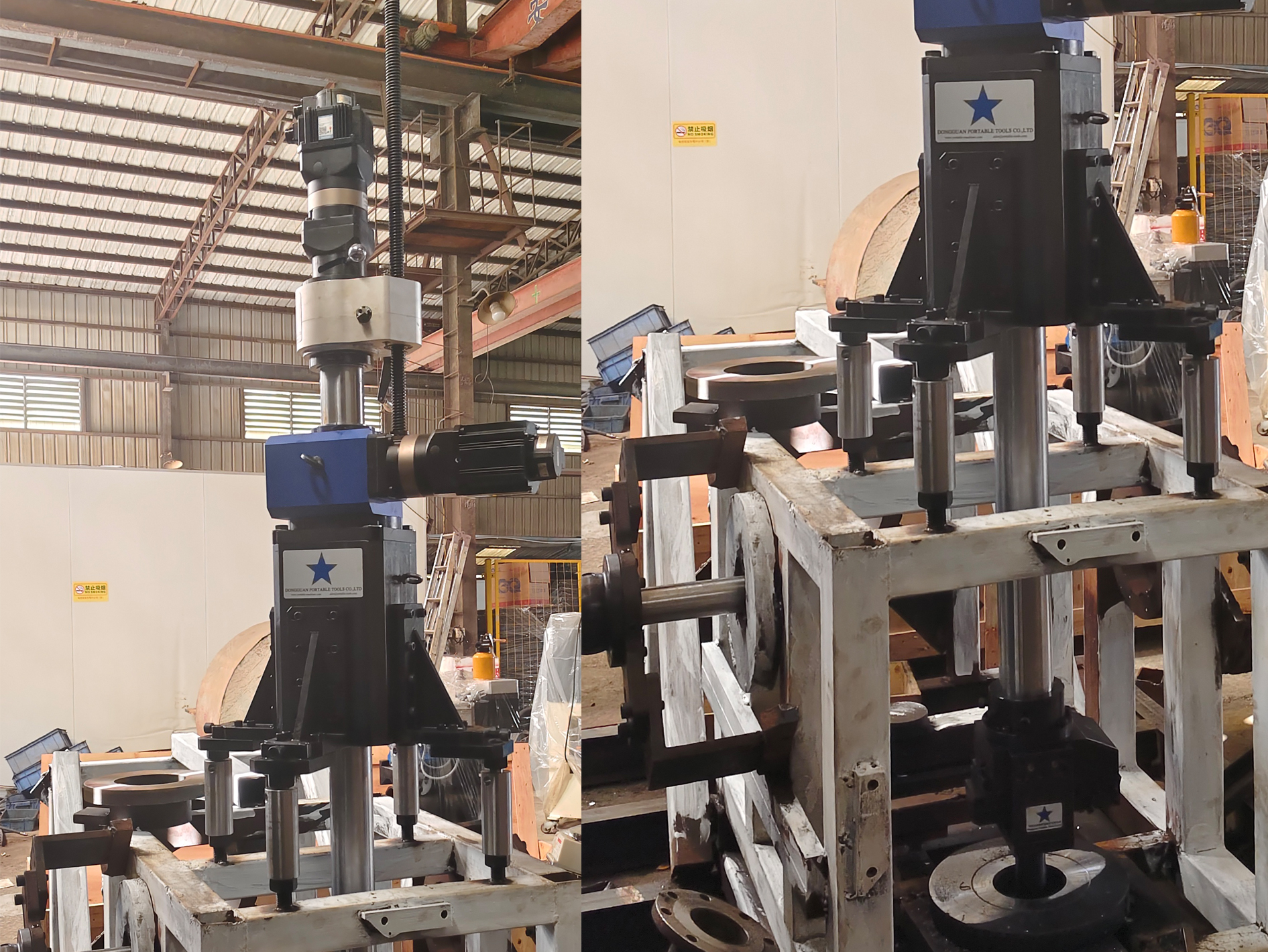
What Is a Valve Seat and Where Is It Used?
A valve seat is a precisely machined sealing surface or seating component that works together with a valve to control, stop, or regulate the flow of fluids, gases, steam, or other media. Depending on the equipment and application, valve seats can be found in engines, hydraulic systems, industrial valves, pumps, compressors, pressure vessels, pipelines, power-generation equipment, mining machinery, marine equipment, oil and gas systems, and heavy industrial machinery.
In many large industrial machines, valve seats are installed inside large and heavy components. The valve seat may contain a deep bore that requires high dimensional accuracy, concentricity, straightness, and surface finish. After long-term operation, corrosion, wear, deformation, or mechanical damage may cause the valve seat bore to become oversized, misaligned, or otherwise unsuitable for continued service.
Traditional machining often requires removing the entire component and transporting it to a large machining center. This can be expensive, time-consuming, and technically difficult. In such situations, a portable line boring machine provides a practical solution for Deep-hole boring of valve seats directly at the worksite.
Why Use a Portable Line Boring Machine for Deep-Hole Valve Seats?
Deep-hole machining presents unique challenges. As the machining depth increases, boring bar deflection, vibration, alignment errors, and cutting-tool stability become increasingly important. For large valve seats, transporting the workpiece to a conventional machine shop may also require extensive dismantling.
An on site line boring machine allows technicians to bring the machining capability directly to the component. Instead of removing a massive valve body, engine component, pipeline assembly, or industrial structure, the machine can be installed directly on the workpiece.
This approach is particularly valuable for valve seats on site boring, where maintaining the original installation position and centerline is important. An in situ line boring machine for valve seats deep hole applications can be configured according to the required bore diameter, machining depth, workpiece geometry, and tolerance.
The major benefits include reduced transportation costs, less disassembly, shorter equipment downtime, flexible installation, and the ability to perform precision machining directly in the field.
Advantages of Deep-Hole Boring of Valve Seats On Site
A professional portable line boring machine offers several advantages for deep-hole valve-seat machining.
1. Reduced Downtime
Large industrial equipment can be extremely expensive to shut down. Removing a valve body or other major component for workshop machining can take days or even weeks. With an on site line boring machine, machining can often be performed directly at the installation location, reducing unnecessary downtime.
2. No Need to Transport Large Components
A large valve body or industrial assembly may weigh several tons. Transporting it to a machining facility requires cranes, trucks, disassembly, and logistical planning. A portable line boring machine reverses the traditional approach: instead of moving the workpiece to the machine, the machine is brought to the workpiece.
3. Improved Alignment
For valve seats on site boring, preserving the original centerline can be extremely important. A properly installed in situ line boring machine for valve seats deep hole can be aligned directly to the existing bore or the required reference geometry.
4. Suitable for Large and Deep Bores
Portable boring equipment can be configured for large diameters and long machining lengths. With suitable boring-bar supports, cutting tools, and drive systems, the machine can provide stable cutting conditions even for demanding Deep-hole boring of valve seats applications.
5. Flexible Customization
Different valve seats require different machining parameters. Bore diameter, depth, material, tolerance, installation space, and surface-finish requirements can vary significantly. A professional portable line boring machine manufacturer can customize the equipment to meet these requirements.
How to Perform Deep-Hole Boring of Valve Seats
The first step is a detailed inspection of the valve seat and surrounding structure. Technicians should measure the existing bore diameter, bore depth, centerline, wear condition, and required final dimensions. The material of the valve seat should also be identified so that suitable cutting tools and machining parameters can be selected.
The second step is machine installation. The on site line boring machine must be securely mounted to the workpiece. Depending on the application, mounting plates, support brackets, adjustable fixtures, or customized mounting structures may be required.
The third and most critical step is alignment. The boring bar must be aligned with the required valve-seat centerline. Precision alignment helps minimize eccentricity, taper, and dimensional errors. For deep-hole machining, boring-bar support should be positioned as close as practical to the machining area to reduce deflection and vibration.
After alignment, the boring bar and cutting tools are installed. For Deep-hole boring of valve seats, the cutting tool should be selected according to the workpiece material, required diameter, machining depth, and surface finish.
Rough Boring
The initial machining stage should normally remove material gradually rather than attempting to achieve the final dimension in one heavy cut. Controlled rough boring establishes the basic bore geometry while reducing the risk of excessive cutting force, vibration, and boring-bar deflection.
Precision Boring
After rough machining, the operator performs semi-finishing and finishing passes. Smaller cutting depths and carefully controlled feed rates can help achieve better dimensional accuracy and surface quality.
During valve seats on site boring, dimensional measurements should be taken throughout the machining process. This allows the operator to identify potential deviations before the final machining pass.
Final Inspection
After completing the bore, the technician should inspect the diameter, depth, straightness, concentricity, cylindricity, surface finish, and overall geometry. Depending on the application, specialized measuring instruments may be used to confirm that the valve seat meets the required engineering specifications.
How to Improve Deep-Hole Valve Seat Machining Quality
The quality of Deep-hole boring of valve seats depends on several factors. Machine rigidity is particularly important. A weak mounting structure or poorly supported boring bar can result in vibration and dimensional errors.
Proper alignment is equally important. Even a high-quality portable line boring machine cannot compensate for incorrect installation. Experienced technicians should carefully establish the machining reference before cutting begins.
Cutting parameters must also be optimized. Cutting speed, feed rate, depth of cut, tool geometry, and coolant or lubrication conditions should be selected according to the workpiece material and machining requirements.
For long and deep holes, boring-bar support is especially important. Properly positioned supports reduce deflection and improve machining stability.
Finally, professional field experience is invaluable. Real-world conditions are often different from workshop environments. An experienced on site line boring machine team can adapt the machine setup and machining process to the actual workpiece and working conditions.
Zhengzhou Portable Tools Co., Ltd. — Professional Manufacturer of Portable On-Site Machine Tools
Zhengzhou Portable Tools Co., Ltd. is a professional manufacturing factory specializing in portable line boring machines and in situ machine tools, and we are committed to being a leading provider in the on-site machining industry.
Producing world-class field machining equipment requires much more than simply assembling a machine. We control quality from engineering design and raw-material selection to CNC manufacturing, component selection, assembly, testing, packaging, and transportation.
Our designers have been deeply involved in on site tools for over 2 decades, bringing extensive practical experience to the design of portable machining equipment. Their understanding of field machining requirements helps us develop machines that are not only technically advanced but also practical and reliable in demanding working environments.
For precision manufacturing, our machines and components are processed using advanced CNC equipment from leading manufacturers, including Germany’s DMG MORI and Japan’s MAZAK, MAKINO, and MITSUI SEIKI. These high-end CNC machining centers help us maintain strict control over machining accuracy, dimensional consistency, and production quality.
We also pay close attention to the quality of critical components. Selected components are sourced from leading German and Japanese manufacturers. For example, Siemens systems are used in our CNC machining centers, while Japanese THK precision linear-motion components, where applicable, and NSK high-precision bearings are used to support reliable mechanical performance. Electrical and motion-control components can include Panasonic motors, Siemens servo systems, and high-quality products from Schneider Electric and ABB, depending on the machine configuration.
Through careful component selection and strict manufacturing control, we aim to achieve excellent machining accuracy, mechanical stability, reliability, and long-term durability. Every detail contributes to our goal of producing world-class portable on-site machining equipment.
Continuous Improvement Through Real Field Experience
One of our important advantages is our own professional field machining team. We do not only manufacture machines; we also use our equipment in real-world machining projects.
This practical experience allows us to continuously improve machine structures, boring systems, mounting methods, cutting strategies, operating procedures, and equipment configurations. At the same time, our production technology and equipment are continuously upgraded based on feedback from actual projects.
This combination of engineering expertise, advanced CNC manufacturing, high-quality components, experienced assembly technicians, and field machining experience helps us continuously improve the stability, practicality, precision, and reliability of our products.
Whether the requirement is Deep-hole boring of valve seats, valve seats on site boring, or an in situ line boring machine for valve seats deep hole, Zhengzhou Portable Tools Co., Ltd. is ready to provide professional solutions.
Customized On-Site Machining Equipment
Different projects require different machining solutions. We provide customized portable line boring machine solutions according to your workpiece dimensions, machining diameter, machining depth, installation environment, accuracy requirements, and production needs.
In addition to portable boring equipment, we can also provide customized portable flange facing machines, portable milling machines, and portable lathes for various field machining applications.
If you require a specialized portable line boring machine, on site line boring machine, or other on-site machining equipment, our OEM/ODM service can help turn your requirements into a dedicated machine solution.
Welcome to customize your own professional on-site machining equipment with Zhengzhou Portable Tools Co., Ltd. Contact us to discuss your project and develop a high-precision, reliable, and application-specific field machining solution.


